

Last Updated: 2 October 2026
Off-Exchange Settlement
Reducing Counterparty Risk in Digital Asset Trading
Market access shouldn’t come at the expense of asset protection.
Off-exchange settlement (OES) separates the custody of assets from the venues where they are traded, allowing institutions to collateralise market activity without transferring assets to an exchange’s balance sheet. This structural shift reduces the counterparty exposure inherent in pre-funded trading models and brings digital asset market participation in line with the standards institutions already expect from traditional finance. As adoption accelerates, OES is becoming a baseline requirement for institutional digital asset access, not a differentiator.
Why it matters
Digital asset markets have repeatedly demonstrated the same structural weakness: assets held on an exchange are exposed to that exchange’s operational, financial, and security risk.
Exchanges are designed to facilitate trading for a large number of participants, making off-chain settlement essential for efficiency, speed, and cost management. However, this model typically requires client assets to be pooled into a limited number of omnibus wallets, some of which must remain connected to the internet as hot wallets to support day-to-day activity. When an exchange fails, institutions holding pre-funded balances become unsecured creditors, with limited recourse and no certainty of recovery.
This is not a risk institutions accept elsewhere. In equities, fixed income, and derivatives markets, custody and execution are structurally separated. Assets sit with a regulated custodian regardless of where they are traded. Off-exchange settlement applies that same principle to digital assets, keeping assets in custody while their value supports active trading, borrowing, or lending.
For institutions operating under fiduciary duties and regulatory obligations, this separation is not optional. It is a prerequisite for responsible market participation in an asset class still building its institutional infrastructure.
The Problem With Pre-Funding
Under a conventional trading arrangement, institutions must transfer assets directly to an exchange or counterparty before trading can begin, exposing them to risks they cannot control or monitor directly.
This creates several compounding problems:
- Counterparty exposure: The institution holds an unsecured claim against the exchange. If the exchange fails, that claim ranks alongside every other creditor.
- Concentration risk: Assets spread across multiple venues create multiple points of exposure, each requiring separate due diligence and monitoring.
- Capital drag: Pre-funding locks up capital that could otherwise be deployed elsewhere, reducing overall capital efficiency.
- Settlement latency: The gap between trade execution and final settlement extends exposure for longer than necessary.
How Do Exchanges Hold Client Assets?
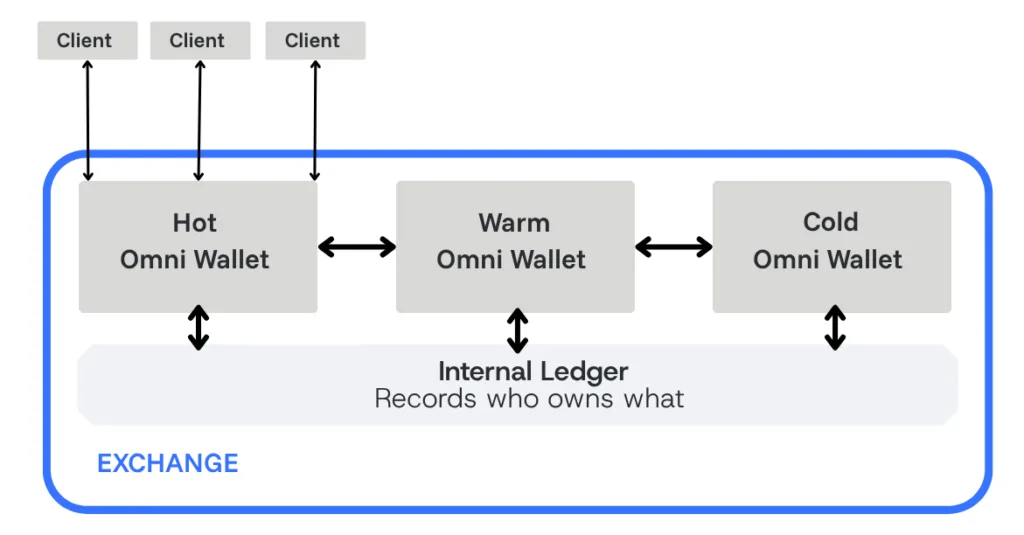
Exchanges typically hold client assets in omnibus wallets, where deposits from many clients are pooled in a small number of wallets controlled by the exchange. Each client’s entitlement is recorded on the exchange’s internal ledger rather than on-chain, which allows trades to settle instantly as book entries.
The trade-off is that the client depends on the exchange for both the accuracy of its records and the security of the private keys. Pooling assets from many clients in a small number of wallets, often kept online to support withdrawals and trading, concentrates value in one place and makes exchanges a high-value target for attackers. A single compromise can affect every client at once. Client assets are commingled, and the same entity operates the venue, holds the keys and keeps the books. If the exchange is hacked or fails, the treatment of client assets rests on its terms of service and the applicable insolvency regime.
How Does Komainu Hold Client Assets?
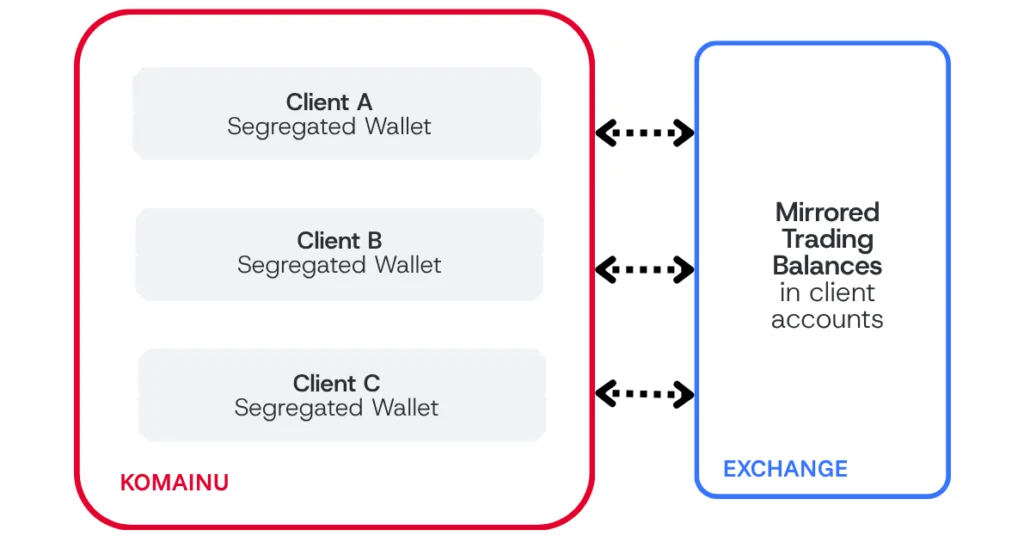
Komainu holds each client’s assets in segregated wallets, verifiable on-chain and kept separate from Komainu’s own assets and those of other clients. Custody and key management operate under defined governance controls and regulatory oversight, independent of any trading venue.
Through Komainu Connect, assets stay in the client’s segregated wallet while a connected exchange extends a matching trading balance, with only net positions settled between the two.
| EXCHANGE CUSTODY | REGULATED CUSTODIAN | |
| WALLET STRUCTURE | Omnibus, pooled | Segregated per client |
| RECORD OF OWNERSHIP | Exchange’s internal ledger | On-chain, identifiable per client |
| KEY CONTROL | Exchange | Custodian, under defined governance |
| OVERSIGHT | Varies by venue and jurisdiction | Regulatory supervision and audit |
| EXPOSURE IF PROVIDER FAILS | Depends on exchange terms and insolvency regime | Legal arrangements designed to protect client assets |
How Off-Exchange Settlement Works
Under an OES model, assets remain with the custodian throughout the trading lifecycle. Komainu acts as the collateral and settlement layer: connected venues and counterparties recognise custodied assets as valid margin or collateral without requiring physical transfer. Settlement takes place through Komainu’s infrastructure, with net positions settled rather than gross asset movements. At no point do client assets leave custody.
What Changes for Counterparty Risk
Under the traditional model, an institution’s primary credit exposure is to the exchange holding its pre-funded balance. Under OES, assets remain with a regulated custodian, and counterparty exposure is limited to the net settlement obligation arising from open positions, not the full value of assets committed to trading.
Settlement obligations still exist, and counterparty due diligence remains important. But the scale and nature of the exposure changes fundamentally: institutional risk is contained to the economics of open positions rather than the value of pre-funded collateral sitting on a third party’s balance sheet.

Key Features
- Custody-first structure: Assets remain in regulated, segregated custody throughout the trading lifecycle.
- Net settlement: Reduces the volume and frequency of asset movements compared to gross transfers.
- Real-time visibility: Institutions retain oversight of collateral positions and margin requirements as they change.
- Automated collateral management: Supports active trading without manual intervention or repeated transfers.
- Institutional-grade reporting: Consolidated reporting across all connected venues and activity.
Capital Efficiency
Beyond risk mitigation, OES improves how efficiently capital is deployed. Custodied assets can be allocated to support trading, borrowing, and lending activity across multiple connected venues. This removes the delay and friction of moving assets in and out of custody, allowing capital already held securely to be put to work faster across the Komainu Connect ecosystem.
The Komainu Connect Ecosystem
Komainu Connect provides OES-enabled access to a network of institutional venues and counterparties. Each connection allows clients to trade, borrow, or lend against custodied assets without those assets leaving Komainu’s custody. Current connections include Deribit, Bybit, OKX, LTP, Ripple Prime, and Gate, with the network continuing to expand as the ecosystem matures.
Komainu’s Perspective
At Komainu, off-exchange settlement reflects a structural principle, not a product feature. Institutions operating in traditional markets would not accept a framework in which assets sit on a trading venue’s balance sheet, and there is no reason to accept that standard in digital assets.
Komainu Connect brings together collateral management, settlement infrastructure, and ecosystem connectivity within a single regulated custody platform. This gives clients the confidence to engage with digital asset markets at scale, with the assets underpinning their activity protected throughout.
As the Komainu Connect network grows, our focus remains on adding counterparties and venues that meet the same institutional standards our clients expect from us, so that every new connection adds capability without adding risk.
Key Takeaways
- Off-exchange settlement removes reliance on exchange balance sheets by keeping client assets in regulated segregated custody throughout the trading lifecycle.
- Institutional counterparty exposure under OES is limited to net settlement obligations, not the full value of pre-funded collateral.
- Custodied assets can be allocated to multiple connected venues, without the delay and friction of moving assets in and out of custody
- Net settlement reduces the frequency and volume of asset transfers compared to traditional gross settlement models.
- OES brings the structural separation of custody and execution, already standard in traditional finance, to digital asset markets.
What Should Clients Ask?
- How are my assets protected throughout the trading and settlement process?
- What is my counterparty exposure under OES compared to pre-funding?
- How is collateral managed and reported across multiple venues?
- Which venues and counterparties are currently connected to the network?
- Who has legal / beneficial ownership?
- Are client assets protected from the exchange’s creditors on insolvency?